Dalian Youyan Plastic Machinery Co., Ltd.
Couplet: Feng Manager
Phone/fax:086-0411-86260347
Hand:18624289888
13604263838
Mail box:21272059@qq.com
Network access:www.dlyouyan.com
Address: Chinese Lushunkou District of Dalian City, the three streams town (take Tuchengzi Dalian to Lushun Road westbound vehicle airport about 200 meters in front of about 100 meters)
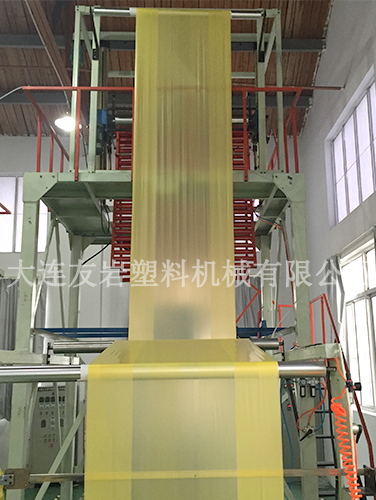
The occurrence of film bubbles during the production process of Dalian plastic blown film machines is a common problem that affects product quality.
1、 Analysis of the causes of bubble formation
1. Raw material issues
Raw material issues are the main factor causing film bubbles:
High moisture content of raw materials: Plastic particles absorb moisture during storage or transportation, and when heated, the moisture evaporates to form bubbles
Raw material contamination: mixing impurities or different grades of raw materials leads to poor compatibility
High proportion of recycled materials: Recycled materials may contain volatile substances or degradation products
Additive issue: Lubricants, antioxidants, and other additives decompose to produce gases
2. Equipment factors
The equipment status directly affects the quality of the film:
Improper temperature setting of extruder: resin decomposition caused by high temperature, poor plasticization caused by low temperature
Screw wear: Decreased conveying and mixing efficiency, resulting in uneven plasticization
Filter blockage: Fluctuations in melt pressure, poor exhaust
Mold design defect: Unreasonable flow channel design leads to unstable melt flow
Cooling system malfunction: Uneven cooling leads to unstable film bubbles
3. Improper process parameters
Unreasonable process parameters are an important cause of bubble formation:
Mismatch between extrusion speed and traction speed: resulting in uneven thickness of film bubbles
Excessive inflation ratio: stress concentration caused by excessive stretching of the film
Improper adjustment of wind ring: uneven cooling airflow affects the stability of film bubbles
Unstable melt pressure: pressure fluctuations lead to uneven film structure
4. Environmental factors
The impact of the production environment cannot be ignored:
High environmental humidity: Raw materials absorb moisture before processing
Large fluctuations in environmental temperature: affecting cooling effectiveness and membrane bubble stability
Intense air flow: external airflow interferes with the formation of film bubbles
2、 Solution to Bubble Problem
1. Raw material processing measures
Raw material pretreatment:
Pre drying treatment is necessary for materials with strong moisture absorption properties (such as PA, PET, etc.), and it is recommended to dry them at 80-100 ℃ for 4-6 hours
Use a dehumidification dryer to ensure that the moisture content of the raw materials is below 0.02%
Different grades of raw materials should be avoided from mixing, and compatibility testing must be conducted before mixing
Control the proportion of recycled materials, generally not exceeding 30%, and high-quality products are recommended to be controlled within 15%
Raw material storage management:
Raw materials should be stored in a dry and ventilated warehouse
The raw material bag should be sealed in a timely manner after opening
Adhere to the principle of "first in, first out" to avoid long-term storage of raw materials
2. Equipment maintenance and adjustment
Extrusion system maintenance:
Regularly check the wear of the screw, and replace it promptly if it is severely worn
Regularly replace the filter screen according to the production situation. Generally, it should be replaced when the pressure rises by 10-15%
Clean the flow channel of the mold head to ensure no material accumulation or carbides
Optimization of temperature control system:
Set reasonable temperature curves based on different raw materials
Regularly calibrate temperature control instruments to ensure accurate temperature display
Avoid local overheating, especially near the mold head
Cooling system adjustment:
Check whether the air outlets of the wind ring are unobstructed to ensure even airflow
Adjust the position of the wind ring to create a better angle between the cooling airflow and the film bubbles
Adjust the air volume and pressure according to the thickness of the film
3. Optimization of process parameters
Temperature parameter setting:
LDPE is generally controlled between 160-210 ℃
HDPE is controlled at 180-230 ℃
LLDPE is controlled at 170-220 ℃
The specific temperature should be adjusted according to the raw material grade and equipment characteristics
Speed matching:
Maintain an appropriate ratio between traction speed and extrusion speed
The inflation ratio is generally controlled between 2-4, with a small value for thick films and a large value for thin films
The height of the membrane bubble should be controlled at 3-5 times the diameter of the mold head
Pressure control:
Maintain stable melt pressure with fluctuation range not exceeding ± 5%
Control pressure by adjusting screw speed and back pressure
After replacing the filter screen, it is necessary to reduce the speed appropriately and wait for the pressure to stabilize before increasing the speed
4. Operating standards and quality control
Standardized operation:
Develop detailed start-up, shutdown, and refueling procedures
Record the process parameters of each production and establish a database
Provide systematic training for operators to reduce human errors
Process monitoring:
Regular sampling and inspection of film quality
Install online monitoring equipment to monitor film thickness and appearance in real-time
If bubbles are found, adjust the parameters immediately and stop the machine for troubleshooting if necessary
Environmental control:
Keep the workshop environment dry and control the relative humidity below 60%
Avoid strong winds blowing directly towards the membrane bubble
Pay attention to insulation in winter and ventilation in summer
3、 Handling of special circumstances
1. Periodic bubbles
Manifested as regular distribution of bubbles on the film:
Check if the screw and barrel are severely worn
Check if the filter is partially clogged
Check if there are any abnormal vibrations in the transmission system
2. Local bubbles
Bubbles only appear at specific locations on the film:
Check if the temperature at the corresponding position of the mold head is abnormal
Check if the corresponding position of the wind ring is blocked
Check if there is any damage or material accumulation on the mold lip
3. Sudden large amount of bubbles
Sudden appearance of a large number of bubbles:
Immediately check if there are any changes in the raw materials
Check if the temperature control system is malfunctioning
Check if any foreign objects have entered the extruder
4、 Preventive measures
Establish a comprehensive equipment maintenance plan and regularly inspect key components
Implement a raw material incoming inspection system to ensure the quality of raw materials
Develop standard operating procedures and strictly implement them
Establish a quality traceability system to record production data for each batch
Regularly provide technical training to employees to improve their problem-solving skills
Through the above systematic analysis and solutions, the problem of bubbles appearing in the film during the production process of plastic blown film machines can be effectively solved, improving product quality and production efficiency. The key is to identify the specific causes of bubble formation and then take targeted measures. At the same time, establishing a preventive mechanism is more important than post-treatment, as it can greatly reduce the incidence of bubble problems.