Dalian Youyan Plastic Machinery Co., Ltd.
Couplet: Feng Manager
Phone/fax:086-0411-86260347
Hand:18624289888
13604263838
Mail box:21272059@qq.com
Network access:www.dlyouyan.com
Address: Chinese Lushunkou District of Dalian City, the three streams town (take Tuchengzi Dalian to Lushun Road westbound vehicle airport about 200 meters in front of about 100 meters)
1、 The hazards of static electricity in blown film production
Static electricity is a common problem in the production process of three-layer co extrusion blown film, which can have various impacts on product quality and production efficiency
Film adhesion problem: Static electricity can cause mutual attraction between film layers, resulting in uneven winding or film adhesion, which affects subsequent processing and use.
Surface defects: Static electricity adsorbs dust and impurities in the air, causing defects on the surface of the film and reducing the appearance quality of the product.
Safety hazard: Accumulation of static electricity to a certain extent may generate electric sparks, posing a risk of fire and explosion in flammable environments.
Difficulty in operation: Static electricity makes it difficult to control the film, affecting the normal operation of operators and reducing production efficiency.
Equipment interference: Strong static electricity may interfere with the normal operation of electronic devices and affect the stability of the production line.
2、 The main cause of static electricity generation
Understanding the causes of static electricity can help with targeted prevention:
Material factors: The frictional charging sequence of different plastic materials (such as PE, PP, PA, etc.) is different, and static electricity is easily generated by interface friction during multi-layer co extrusion.
Process parameters: Improper process parameters such as extrusion speed, temperature, and traction speed can exacerbate static electricity generation.
Environmental conditions: Low humidity environments (relative humidity below 40%) are more likely to generate and accumulate static electricity.
Equipment factors: Friction between metal rollers and thin films, poor grounding of equipment, etc. can all lead to static electricity problems.
Personnel operation: Improper operation methods may increase friction and exacerbate static electricity generation.
3、 Specific measures to prevent static electricity
1. Material selection and formula optimization
Add anti-static agent: Add internal anti-static agent (migration type) or external anti-static agent (coating type) to the raw material to reduce surface resistance.
Material combination optimization: Reasonably design a three-layer structure, placing materials that are prone to static electricity in the middle layer to reduce surface friction.
Use conductive fillers: Add appropriate amounts of conductive fillers such as carbon black and metal oxides to improve the conductivity of the film.
2. Equipment improvement and maintenance
Improve grounding system: Ensure that all metal components (molds, rollers, frames, etc.) are well grounded, and the grounding resistance should be less than 4 Ω.
Install static eliminators: Install ion air rods, static eliminators, and other equipment at critical locations (such as before traction and winding).
Use conductive rollers: Replace some metal rollers with conductive rubber rollers to reduce friction and electricity generation.
Equipment cleaning and maintenance: Regularly clean the equipment to prevent dust accumulation from affecting static electricity dissipation.
3. Optimization of process parameters
Control extrusion temperature: Increasing the processing temperature appropriately can reduce the material resistivity, but it is necessary to avoid overheating degradation.
Adjust traction speed: Find a better speed balance point to avoid excessive speed and increased friction.
Optimize cooling system: Ensure uniform cooling of the film and reduce charge separation caused by temperature differences.
Control the stability of membrane bubbles: Stable membrane bubbles can reduce friction and decrease static electricity generation.
4. Environmental control
Humidity regulation: Keeping the relative humidity of the production environment between 50-60% is beneficial for static dissipation.
Air purification: Use an air filtration system to reduce dust and particulate matter in the environment.
Temperature control: Maintain a constant ambient temperature to avoid temperature fluctuations affecting material properties.
5. Operating standards
Standardize operating procedures: Develop standard operating procedures to reduce unnecessary friction and contact.
Personnel protection: Operators should wear anti-static work clothes and shoes, and use anti-static tools.
Regular testing: Use an electrostatic tester to regularly measure the static voltage on the surface of the film and promptly identify any issues.
4、 Application of Static Electricity Elimination Technology
Ionizing eliminator: It neutralizes the surface charge of a thin film by generating positive and negative ions through high-pressure ionization of air.
Radioactive eliminator: using radioactive isotopes to ionize air, suitable for use in hazardous areas.
Inductive eliminator: induces surface charges on thin films and generates opposite charges for neutralization.
Combination elimination: Multiple elimination techniques are used in combination according to the specific situation of the production line.
5、 Quality monitoring and continuous improvement
Establish an electrostatic detection system: regularly measure the surface resistivity and electrostatic voltage of thin films.
Record and analyze data: Establish a database of static electricity issues, analyze trends and influencing factors.
Continuous improvement measures: Continuously optimize process parameters and equipment configuration based on test results.
Employee training: Regularly provide anti-static knowledge training to operators to improve their ability to identify and handle problems.
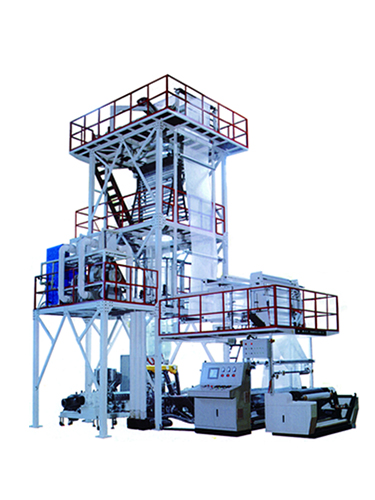
The static electricity problem in the production of three-layer co extrusion blown film needs to be comprehensively considered from multiple aspects such as materials, equipment, processes, environment, and personnel, and systematic prevention and elimination measures should be taken. Through scientific management and technological innovation, static electricity problems can be effectively controlled, and product quality and production efficiency can be improved. Enterprises should develop suitable anti-static solutions based on their own production conditions and product requirements, and continuously optimize and improve them to meet the growing demand for high-quality film products in the market.