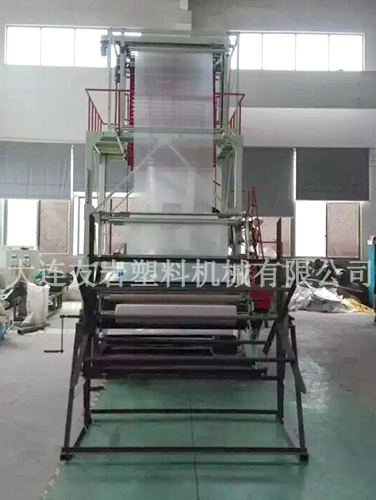
Dalian Youyan Plastic Machinery Co., Ltd.
Couplet: Feng Manager
Phone/fax:086-0411-86260347
Hand:18624289888
13604263838
Mail box:21272059@qq.com
Network access:www.dlyouyan.com
Address: Chinese Lushunkou District of Dalian City, the three streams town (take Tuchengzi Dalian to Lushun Road westbound vehicle airport about 200 meters in front of about 100 meters)
The occurrence of film breakage during the production process of Dalian plastic blown film machines is a common but serious problem that affects production efficiency and product quality.
1、 Analysis of the main causes of membrane rupture
1. Raw material issues
Poor quality of raw materials: Raw materials containing impurities, moisture, or degradation can lead to a decrease in membrane bubble strength
Improper formula ratio: Too many or too few additives, such as a mismatch in the ratio of lubricants and anti-static agents
Insufficient drying of raw materials, especially moisture absorbing materials such as nylon, PET, etc
2. Equipment factors
Mold head problem: uneven mold head temperature, material accumulation or damage at the mold mouth
Cooling system malfunction: improper angle of the air ring, uneven air volume, or high temperature of the cooling water
Traction device issue: uneven pressure on the pinch roller, mismatch between traction speed and extrusion speed
3. Improper process parameters
Unreasonable temperature setting: The temperature in each area is too high or too low
Excessive screw speed: leading to high melt pressure or uneven plasticization
Excessive inflation ratio: exceeding the material's tolerance limit
4. Operational factors
Improper startup operation: Start up too quickly or before the temperature reaches the set value
Human interference: Operators touching membrane bubbles or adjusting parameters too aggressively
2、 System solution for membrane rupture problem
1. Raw material control measures
Strict raw material inspection: Check the raw materials for impurities, clumps, or discoloration before use
Adequate drying treatment: Set appropriate drying temperature and time according to material characteristics
PE/PP material: 80-100 ℃, 2-4 hours
PA/PET material: 120-150 ℃, 4-6 hours
Optimize formula ratio: gradually adjust the dosage of additives and record the effect after each adjustment
2. Equipment inspection and maintenance
Mold maintenance:
Regularly disassemble and clean the mold head to remove carbon deposits and degradation products
Check if there are scratches or damage on the mold mouth, and polish it if necessary
Ensure that the heating ring of the mold head is working properly and the temperature distribution is uniform
Cooling system adjustment:
Check if the air outlets of the air ring are unobstructed and adjust the angle of the air ring (usually 15-45 °)
Measure the cooling air velocity to ensure even distribution (generally 4-10m/s)
Check the water temperature (recommended 10-25 ℃) and flow rate of the water cooling system
Traction device calibration:
Check the parallelism and pressure of the pinch roller (usually 0.2-0.5MPa)
Calibration of the matching relationship between traction speed and extrusion speed
3. Optimization of process parameters
Temperature control:
Segmented temperature setting to avoid sudden temperature changes
Typical temperature settings (using LDPE as an example):
Feeding section: 140-160 ℃
Compression section: 170-190 ℃
Measurement section: 180-200 ℃
Mold head: 190-210 ℃
Screw speed adjustment:
Gradually increase the rotational speed based on the stability of the membrane bubble
Maintain the melt pressure within a reasonable range (usually 10-25MPa)
Inflation ratio control:
Generally, the inflation ratio is controlled between 1.5-4:1
The thick film should be taken as a smaller value, while the thin film can be appropriately increased
4. Operating standards
Standard startup procedure:
Preheat the equipment to the set temperature and keep it warm for 30 minutes
Start the extruder at low speed (10-20rpm)
Observe the formation of membrane bubbles and gradually increase the speed
Adjust other parameters after reaching a stable production state
Monitoring during operation:
Regularly check the shape of the membrane bubbles and the cooling effect
Immediate deceleration treatment upon discovery of minor rupture
Record each parameter adjustment and corresponding effect
3、 Emergency response to special circumstances
1. Sudden large-scale rupture of the membrane
Immediately press the emergency stop button
Check for foreign objects entering the extrusion system
Check if there is local overheating in the heating system
2. Periodic membrane rupture
Check for wear on the screw and barrel
Confirm if the feeding system is uniform
It may be caused by unbalanced rotating components. Check the transmission system
3. Repeated membrane rupture at specific locations
Mark the location of the membrane rupture and check the corresponding mold mouth and air ring at that position
Possible local temperature anomalies or uneven cooling
4、 Preventive maintenance recommendations
Establish a regular maintenance plan:
Weekly: Clean the mold head and check the heating element
Monthly: Calibrate temperature sensor, check screw wear
Quarterly: Conduct a comprehensive inspection of the transmission system and electrical components
Operator training:
Training on equipment structure and working principle
Training on common fault identification and handling
Training on Safety Operating Procedures
Establish a production record system:
Record the parameter settings for each production run
Record abnormal situations and handling measures
Analyze historical data to identify optimization space
Through the above systematic analysis and solutions, most of the film breaking problems of blown film machines can be effectively controlled and prevented. The key is to identify the root cause, take targeted measures, and establish preventive mechanisms to ensure sustained and stable production.