Dalian Youyan Plastic Machinery Co., Ltd.
Couplet: Feng Manager
Phone/fax:086-0411-86260347
Hand:18624289888
13604263838
Mail box:21272059@qq.com
Network access:www.dlyouyan.com
Address: Chinese Lushunkou District of Dalian City, the three streams town (take Tuchengzi Dalian to Lushun Road westbound vehicle airport about 200 meters in front of about 100 meters)
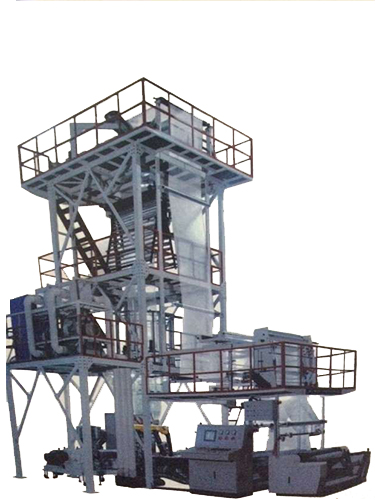
The three-layer co extrusion blown film machine is an advanced equipment that can simultaneously extrude three different materials and composite them together. Its thickness control is more complex compared to single-layer blown film machines. The uniformity of film thickness directly affects the physical properties, appearance quality, and service life of the product. To adjust the thickness of the film, it is necessary to first understand its basic principles.
During the blown film process, the thickness of the film is mainly affected by the following factors:
Temperature settings for each section of the extruder
Screw speed and extrusion volume
Gap and structure of mold head
Efficiency of cooling system
Traction speed and inflation ratio
Proportion distribution of materials in each layer
The unique feature of the three-layer co extrusion blown film machine is the need to coordinate the extrusion ratio of three materials simultaneously to ensure that the thickness of each layer meets the design requirements. Usually, the middle layer (core layer) accounts for a large proportion, and the inner and outer surface layers are thin but have strong functionality.
2、 Mechanical adjustment method
1. Adjustment of die gap
The mold head is a key component that determines the initial thickness of the film. The three-layer co extrusion die has a complex structure and is usually equipped with adjustable die lips:
(1) Use a dedicated thickness gauge to detect the thickness distribution in the circumferential direction of the film
(2) According to the measurement results, fine tune the bolt by adjusting the lip of the mold
(3) Clockwise rotation of the bolt can reduce the gap, while counterclockwise rotation can increase the gap
(4) After adjustment, wait for 10-15 minutes for the system to stabilize before re measuring
Notes:
The adjustment range should be small, not exceeding 1/8 turn each time
The adjustment of adjacent bolts should be coordinated to avoid creating a "wavy" thickness distribution
After adjustment, it is necessary to rebalance the internal pressure of the mold head
2. Wind ring adjustment
The wind ring has a significant impact on the cooling uniformity of the film:
(1) Check the smoothness of each air outlet of the wind ring
(2) Adjust the distance between the wind ring and the membrane bubble (usually 1.5-2 times the diameter of the mold head)
(3) Balance the cooling air flow in all directions through the air volume control valve
(4) Observing the shape of the membrane bubble, the ideal "frost line" should be a horizontal circular shape
3. Traction system adjustment
The traction speed is inversely proportional to the thickness:
(1) Increasing the traction speed will make the film thinner, otherwise it will thicken
(2) When adjusting, the inflation ratio should be considered synchronously to maintain coordination between the two
(3) The traction roller pressure should be uniform to avoid local thickness changes
3、 Method for adjusting process parameters
1. Temperature control
The temperature settings of each section directly affect the fluidity and thickness distribution of the melt:
(1) Barrel temperature: It should rise in a gradient from the feeding section to the metering section
(2) Mold head temperature: usually 5-10 ℃ lower than the end of the barrel
(3) The temperature of each layer of material should be coordinated to avoid interlayer separation caused by temperature differences
(4) Temperature fluctuation controlled within ± 1 ℃
2. Screw speed adjustment
The screw speed determines the extrusion amount and affects the thickness ratio of each layer:
(1) Calculate the required extrusion amount for each layer based on the target thickness
(2) Adjust the speed of each screw through a frequency converter
(3) The speed change should be gentle to avoid sudden pressure changes
(4) After adjustment, it is necessary to observe the change in melt pressure
3. Inflation ratio control
The inflation ratio (bubble diameter/die diameter) affects the longitudinal and transverse thickness:
(1) Generally controlled between 2.0-3.0
(2) Inflation ratio increases, lateral stretching strengthens, and thickness decreases
(3) Need to be adjusted in conjunction with the traction speed
4、 Special adjustment techniques for three-layer co extrusion
1. Adjustment of interlayer ratio
(1) Control the interlayer ratio through the screw speed of each extruder
(2) Real time monitoring of the thickness of each layer using an online thickness gauge
(3) When the proportion is imbalanced, prioritize adjusting the core layer before adjusting the surface layer
2. Interface integration control
(1) Ensure that the temperature of each layer of melt matches
(2) Adjust the convergence angle inside the co extrusion die
(3) Add compatibilizers as necessary to improve interlayer adhesion
3. Coordination of material properties
(1) Choose a combination of materials with similar flowability
(2) High viscosity materials should be distributed in thicker layers
(3) Consider the differences in shrinkage rates of each layer
5、 Common problems and solutions
1. Large fluctuations in thickness
Possible reasons:
Uneven temperature of the mold head
Uneven cooling
Extrusion pressure fluctuation
Solution:
Check the working status of the heating coil
Clean the air ring and adjust the air volume distribution
Stable raw material supply and screw speed
2. Imbalance of interlayer thickness ratio
Possible reasons:
A certain extruder is not feeding smoothly
Screw wear leads to changes in extrusion volume
Changes in material fluidity
Solution:
Check the feeding system
Measure screw clearance
Adjust the temperature of this layer or replace the filter screen
3. Vertical stripes
Possible reasons:
Damage or carbon buildup on the lip mold
melt fracture
The surface of the traction roller is uneven
Solution:
Polishing die lip
Raise the melt temperature or lower the extrusion speed
Check the status of the traction roller
6、 Optimize and adjust the operational process
Preparation before startup:
Check if each regulating mechanism is flexible
Confirm the calibration status of the thickness gauge
Prepare a record form
Preliminary adjustment:
Set temperature and speed based on empirical parameters
Start at low speed and observe the morphology of the membrane bubbles
Preliminary adjustment of lip gap
Fine tuning:
After running at full speed, measure the thickness
Draw a thickness distribution curve
Targeted adjustment of problem areas
Stable production:
Lock each regulating mechanism
Set process parameter alarm limit
Regularly inspect thickness changes
7、 Advanced thickness control technology
Modern three-layer co extrusion blown film machines are often equipped with automatic control systems:
Online thickness measurement system:
Real time monitoring of infrared or X-ray thickness gauge
Data feedback to the control system
Automatically adjust the speed of the lip bolt or screw
Automatic wind ring:
Partition independent control of air volume
Automatically adjust according to the shape of the membrane bubble
Fast response speed and high control accuracy
Intelligent control system:
Storage optimization process parameters
Automatically compensate for the impact of environmental changes
Predictive maintenance function
8、 Safety precautions
When adjusting the mold lip, it must be stopped or run at low speed
High temperature components need to be protected to avoid burns
Adjustment tools should be specialized to prevent damage to the equipment
Maintain a safe distance when observing membrane bubbles
The emergency stop device must be reliable and effective
Through the above systematic adjustment methods, operators can effectively control the film thickness of the three-layer co extrusion blown film machine and produce high-quality composite film products that meet various application requirements. In actual production, the combination of experience accumulation and instrument measurement is necessary to achieve better thickness control effects.