Dalian Youyan Plastic Machinery Co., Ltd.
Couplet: Feng Manager
Phone/fax:086-0411-86260347
Hand:18624289888
13604263838
Mail box:21272059@qq.com
Network access:www.dlyouyan.com
Address: Chinese Lushunkou District of Dalian City, the three streams town (take Tuchengzi Dalian to Lushun Road westbound vehicle airport about 200 meters in front of about 100 meters)
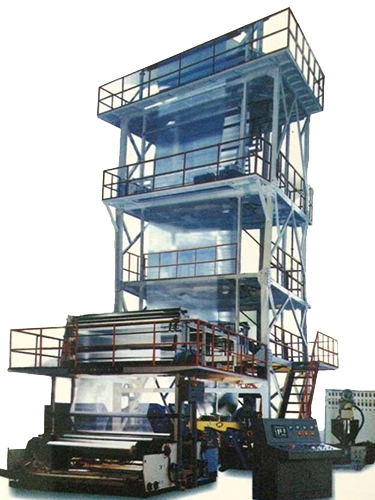
The three-layer co extrusion blown film machine is an efficient equipment used for producing multi-layer composite films, widely used in packaging, agriculture, medical and other fields. The core working principle is to melt plastics of different materials or colors through multiple extruders, squeeze them together into a mold head, and finally form multi-layer composite films through steps such as blowing, cooling, and pulling. The following is a detailed analysis of the working principle of the three-layer co extrusion blown film machine.
1. Raw material preparation and extrusion
The core part of the three-layer co extrusion blown film machine consists of three independent extruders, each responsible for processing a type of plastic raw material. Common raw materials include polyethylene (PE), polypropylene (PP), polyamide (PA), ethylene vinyl acetate copolymer (EVA), etc. The raw materials can be in granular or powder form and enter the extruder through a hopper.
Inside the extruder, the raw material is heated to a molten state. An extruder typically consists of a screw and a heating system. The screw rotates to push the raw material forward, while the heating system gradually melts the raw material. The design and rotational speed of the screw directly affect the uniformity and extrusion efficiency of the melt. Three extruders melt different materials and transport them to the co extrusion die through their respective channels.
2. Co extrusion die head
The co extrusion die is a key component of a three-layer co extrusion blown film machine, which functions to layer and merge the molten plastic from the three extruders into a multi-layered tubular structure. The mold head is designed with multiple layers of flow channels to ensure that each layer of material remains independent and evenly distributed during the extrusion process.
Inside the mold head, three layers of molten plastic are stacked in sequence, and the materials for the inner, middle, and outer layers are arranged according to design requirements. The temperature and pressure control of the die head is crucial to ensure that the materials of each layer do not mix with each other during the extrusion process, while also being tightly adhered.
3. Blowing and Forming
The tubular melt extruded from the die enters the inflation stage. At this point, compressed air is injected into the interior of the tubular melt through the ventilation hole at the center of the die, causing it to expand into thin film bubbles. The key parameters of the inflation process include the inflation ratio (the ratio of the diameter of the film bubble to the diameter of the mold head) and the traction speed, which directly affect the thickness and performance of the film.
During the inflation process, the thin film bubbles gradually extend upwards and are cooled by the cooling system. The cooling system usually consists of a wind ring and a cooling water ring. The wind ring uniformly cools the film bubbles through high-speed airflow, while the cooling water ring further reduces the temperature of the film, allowing it to solidify and form.
4. Traction and winding
The formed film bubble is pulled out by the traction device and gradually flattened into a double-layer film after passing through the guide roller and flattening roller. The speed of the traction device is matched with the extrusion speed and inflation ratio to ensure that the thickness and width of the film meet the requirements.
The flattened film enters the winding device and is wound up through a tension control system. During the winding process, the tension of the film must be kept stable to avoid wrinkles or deformation. The rolled film can be cut or further processed as needed.
5. Control system
The operation of the three-layer co extrusion blown film machine cannot be separated from advanced control systems. Control systems typically include modules such as temperature control, pressure control, speed control, and thickness control. Through PLC (Programmable Logic Controller) and touch screen interface, operators can monitor and adjust equipment parameters in real time, ensuring the stability of the production process and consistency of product quality.
6. Advantages of Multilayer Thin Films
The film produced by the three-layer co extrusion blown film machine has the following advantages:
Functional diversification: By combining different materials, films can be endowed with various functions, such as barrier properties, heat resistance, tear resistance, etc.
Cost saving: While ensuring performance, lower priced raw materials can be used as intermediate layers to reduce production costs.
Beautiful appearance: By combining materials of different colors, films with unique appearances can be produced.
7. Application Fields
The thin films produced by the three-layer co extrusion blown film machine are widely used in the following fields:
Packaging industry: such as food packaging, pharmaceutical packaging, industrial packaging, etc.
Agriculture: such as plastic film, greenhouse film, etc.
Medical: such as medical packaging film, protective film, etc.
Architecture: such as waterproof membrane, thermal insulation membrane, etc.
The three-layer co extrusion blown film machine achieves efficient production of multi-layer composite films through the collaborative work of multiple extruders, combined with co extrusion die heads, blowing, cooling, traction and other process steps. The core of its working principle lies in the independent extrusion and uniform composite of each layer of material, as well as precise process control. With the continuous development of plastic processing technology, the performance and application range of three-layer co extrusion blown film machines will continue to improve, providing higher quality film products for various industries.