Dalian Youyan Plastic Machinery Co., Ltd.
Couplet: Feng Manager
Phone/fax:086-0411-86260347
Hand:18624289888
13604263838
Mail box:21272059@qq.com
Network access:www.dlyouyan.com
Address: Chinese Lushunkou District of Dalian City, the three streams town (take Tuchengzi Dalian to Lushun Road westbound vehicle airport about 200 meters in front of about 100 meters)
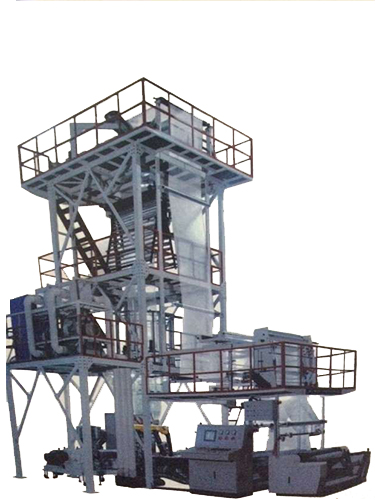
The three-layer co extrusion blown film machine is an efficient equipment widely used in the production of plastic films. Its working principle is to melt and extrude plastics of different materials or colors through three-layer co extrusion technology, and then blow expand them into thin films. However, in the actual production process, the equipment may encounter various malfunctions that affect production efficiency and product quality. The following is an analysis and solution to common faults of three-layer co extrusion blown film machines:
1. Uneven film thickness
Fault phenomenon: Inconsistent film thickness, locally too thick or too thin.
Cause analysis:
The uneven temperature of the mold head leads to inconsistent fluidity of the melt.
The screw speed of the extruder is unstable or the extrusion volume is uneven.
The poor cooling effect of the wind ring leads to uneven expansion of the thin film.
resolvent:
Check the heating system of the mold head to ensure uniform temperature in all areas.
Adjust the screw speed to ensure stable extrusion volume.
Check the distribution of air volume in the air ring to ensure even cooling.
2. Crystal dots or impurities appear on the surface of the film
Fault phenomenon: There are granular impurities or crystal dots on the surface of the film.
Cause analysis:
Impurities are mixed in the raw materials or they are not fully melted.
There are residues inside the screw or die.
The filter screen is damaged or blocked.
resolvent:
Check the quality of raw materials to ensure there are no impurities.
Regularly clean the screw and mold head to remove any residue.
Replace or clean the filter screen.
3. Poor transparency of the film
Fault phenomenon: Insufficient transparency of the film, resulting in fog or turbidity.
Cause analysis:
Improper selection of raw materials or unreasonable mixing ratios.
The extrusion temperature is too low, resulting in poor plasticization of the melt.
The cooling rate is too fast, resulting in high crystallinity.
resolvent:
Optimize the raw material ratio and select suitable resin materials.
Raise the extrusion temperature to ensure sufficient plasticization of the melt.
Adjust the cooling speed to avoid rapid cooling.
4. Wrinkles or creases appear on the film
Fault phenomenon: Wrinkles or creases appear on the surface of the film.
Cause analysis:
Uneven pressure or inconsistent rotational speed of the traction roller.
Uneven cooling of the film leads to inconsistent shrinkage.
Improper control of winding tension.
resolvent:
Check the traction roller to ensure uniform pressure and consistent speed.
Adjust the air ring cooling system to ensure even cooling of the film.
Optimize the winding tension to avoid being too tight or too loose.
5. Film adhesive roller or adhesive mold
Fault phenomenon: The film adheres to the traction roller or die head.
Cause analysis:
The high temperature of the mold head leads to an increase in the viscosity of the melt.
The surface of the traction roller is not smooth or the cleanliness is insufficient.
Excessive additives or unreasonable formula in the raw materials.
resolvent:
Reduce the temperature of the mold head and decrease the viscosity of the melt.
Clean the surface of the traction roller to ensure smoothness and no residue.
Optimize the raw material formula and reduce the use of viscous additives.
6. Excessive equipment noise
Fault phenomenon: The device emits abnormal noise during operation.
Cause analysis:
The screw or bearing is severely worn.
Insufficient lubrication of transmission components.
The unstable installation of the equipment leads to vibration.
resolvent:
Check the screws and bearings, and replace them if necessary.
Regularly add lubricating oil to ensure good lubrication of transmission components.
Strengthen equipment installation to reduce vibration.
7. Irregular film winding
Fault phenomenon: The edges of the rolled film are uneven or the tightness is inconsistent.
Cause analysis:
Improper control of winding tension.
Inconsistent film width or uneven edge thickness.
The winding device is not aligned properly.
resolvent:
Adjust the winding tension to ensure moderate tightness.
Check the width and edge thickness of the film to ensure uniformity.
Adjust the winding device to ensure accurate alignment.
8. Sudden shutdown of equipment
Fault phenomenon: The equipment suddenly stops working during operation.
Cause analysis:
Power failure or circuit overload.
The temperature control system is abnormal, triggering the protection mechanism.
Mechanical components are stuck or damaged.
resolvent:
Check the power supply and circuit, and troubleshoot.
Check the temperature control system to ensure normal operation.
Inspect mechanical components, repair or replace damaged parts.
9. Uneven color of the film
Fault phenomenon: The color of the film is uneven or there is color difference.
Cause analysis:
Uneven mixing of pigments or masterbatch.
Improper temperature control in various areas of the extruder.
The raw material batches are inconsistent.
resolvent:
Ensure that the pigment or masterbatch is thoroughly mixed.
Adjust the temperature of each section of the extruder to ensure uniform melting.
Use the same batch of raw materials to avoid color difference.
10. Insufficient tensile strength of the film
Fault phenomenon: The film is prone to tearing or has insufficient tensile strength.
Cause analysis:
Improper selection of raw materials or unreasonable formula.
The extrusion temperature is too high, causing molecular chain breakage.
The cooling rate is too fast, which affects the crystallinity of the film.
resolvent:
Optimize the raw material formula and select high-strength resins.
Reduce the extrusion temperature to avoid molecular chain breakage.
Adjust the cooling rate to ensure moderate crystallinity of the film.
The malfunction of a three-layer co extrusion blown film machine is usually closely related to factors such as equipment parameters, raw material quality, and operating processes. By regularly maintaining equipment, optimizing process parameters, and strictly controlling raw material quality, the occurrence of failures can be effectively reduced, and production efficiency and product quality can be improved. In practical operation, operators should be familiar with equipment performance, master common troubleshooting methods, and ensure smooth production.