Dalian Youyan Plastic Machinery Co., Ltd.
Couplet: Feng Manager
Phone/fax:086-0411-86260347
Hand:18624289888
13604263838
Mail box:21272059@qq.com
Network access:www.dlyouyan.com
Address: Chinese Lushunkou District of Dalian City, the three streams town (take Tuchengzi Dalian to Lushun Road westbound vehicle airport about 200 meters in front of about 100 meters)
Key Points for Raw‑Material Change of 3‑Layer Co‑Extrusion Blown‑Film Machine
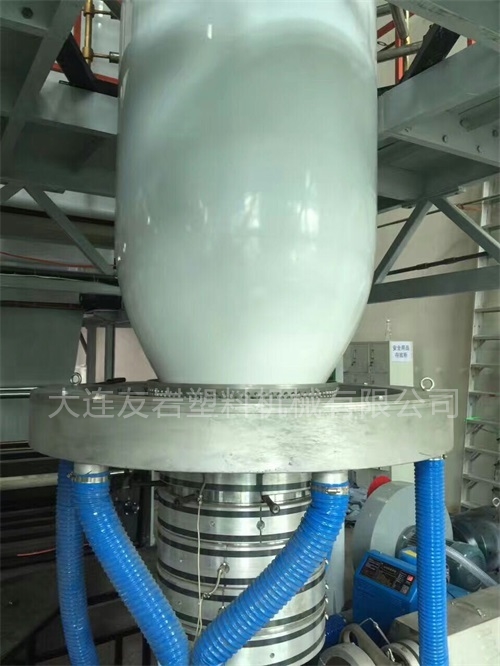
Featuring synchronous three‑layer extrusion and combined multi‑layer performance, 3‑layer co‑extrusion blown‑film machines are widely used in packaging. Raw‑material change involves machine purging, temperature adjustment and process matching. Improper operation may cause material contamination, substandard film performance or even equipment damage. Key points shall be followed to ensure smooth production and stable product quality.
I. Preparations: Clarify differences and plan in advance
Sort out key properties of new and old materials before material change: melting point, melt index and processing temperature range. For example, switching from PE to PP has a melting‑point difference over 50 ℃, bringing higher purging difficulty than switching between LLDPE and LDPE. Check material compatibility. For incompatible material pairs such as PE to EVOH barrier resin, prepare dedicated purging compound to avoid mixed residual materials. Prepare non‑metallic die scrapers, spare filter screens and temperature calibrators. Plan discharging sequence: stop three‑layer feeding simultaneously and reduce screw speed gradually instead of shutting down a single layer, to prevent uneven material inside flow channels.
II. Purging: Complete residue removal, focus on die head
Purging is critical to eliminate cross‑contamination. Raise processing temperature by 10‑20 ℃ based on old‑material setting to improve melt flowability, and lower screw speed slowly. Observe color and uniformity of discharged melt until no old‑material residue remains. The process takes 30‑60 minutes depending on screw size. Pay special attention to the converging die head with narrow flow passages prone to residue buildup. Clean dead corners with dedicated scrapers after temperature stabilization; hard‑metal striking is forbidden. For highly incompatible materials, run dedicated purging compound 1‑2 times to flush die‑head inner walls and protect barrier and heat‑seal layers.
III. Parameter adjustment: Match temperature and process
Pre‑heat barrels, screws and die head for 1.5 hours in advance, keeping temperature deviation within ±5 ℃ to avoid uneven melting or material degradation. When switching from PE to PP, raise die‑head temperature gradually from 160 ℃ to 220‑260 ℃ with low‑speed screw rotation to prevent thermal decomposition of residual melt. Tune parameters for new‑material characteristics: reduce screw speed by 10‑15 % for high‑melt‑index materials to prevent excessive die pressure. Increase air‑ring airflow for high‑crystallinity PP to eliminate crystal spots. Adjust die gap and blow‑up ratio; keep blow‑up ratio at 2‑3 for PP films to counter crystallization shrinkage and ensure uniform film width.
IV. Startup & commissioning: Sample test for stable production
Extrude small volume of new material at low speed after purging. Adjust haul‑off speed and cooling airflow when die output becomes uniform. Once bubble stabilizes, take continuous samples to test thickness tolerance, tensile strength, transparency and other indicators before full‑scale production. In case of surface impurities or uneven color, stop the machine to check flow‑channel residue or filter screens and revise parameters to avoid defective batches.
In summary, raw‑material change for 3‑layer co‑extrusion blown‑film machines relies on thorough purging, accurate temperature setting and matched process parameters. Special attention shall be paid to transition between incompatible materials to safeguard equipment, product quality and production efficiency.